What does American football look like in a country most Americans couldn’t find on a map?
Inside Belarus’s little-known gridiron scene, where players risk broken bones and spend their own money for a handful of games
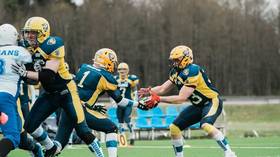

Bison and Hurricanes are normal names for American football teams. How about the Litwins, though? Well, it’s normal if you happen to be in Belarus and in love with the real form of football. This July, the Litwins were crowned league champions after slaughtering the Bison 42-0 in the American Football League 9 Final. But just how is such a foreign sport surviving in a country that most Americans couldn’t find on a map?
The country’s leading club, the Minsk Zubrs (Bison), were formed in 1991 and initially had to rely on competition outside the country. They became three-time champions of the CIS nations, champions of Ukraine, Baltic champions, and, finally, properly Belarusian champs having faced Belarusian opposition. The founders, who all came from other sports, formed a vibrant community in the Belarusian capital, proselytizing to show the newly independent nation that there was, according to an early recruiting slogan, a “better form of football.”
However, attempts to expand and grow new clubs have proved difficult, as despite assistance from the Ministry of Sport and local governments, preference in Belarus goes to Olympic sports, with other pursuits seen as hobbies. The similarities between rugby and American football helped. Many players switched back and forth between the two, getting their fix for hitting people or being hit. Nevertheless, difficulties remain.
“It is hard for clubs,” Yevhen told me over a coffee in downtown Minsk. “The costs to play are a lot and we don’t [have] reserves of players.”
Yevhen has played for the Zubrs, having previously had a decent career at the national level in track and field.
“I got to play because, you know, you finish one sport, then just the gym is left, but still want to compete and one [colleague] invited me. It was difficult because it was expensive and not so many games.”
Lack of game time was mentioned by everyone that I spoke with in Belarus. As one player joked, “It’s like preparing for your wedding every day, but never getting married.”
Making a ‘wedding’ more difficult is the divorce of Belarusian football from international competition. The Baltic states, especially Lithuania, vehemently refuse to even contemplate interaction with local teams, while playing with Ukrainian clubs is not on the horizon for now.
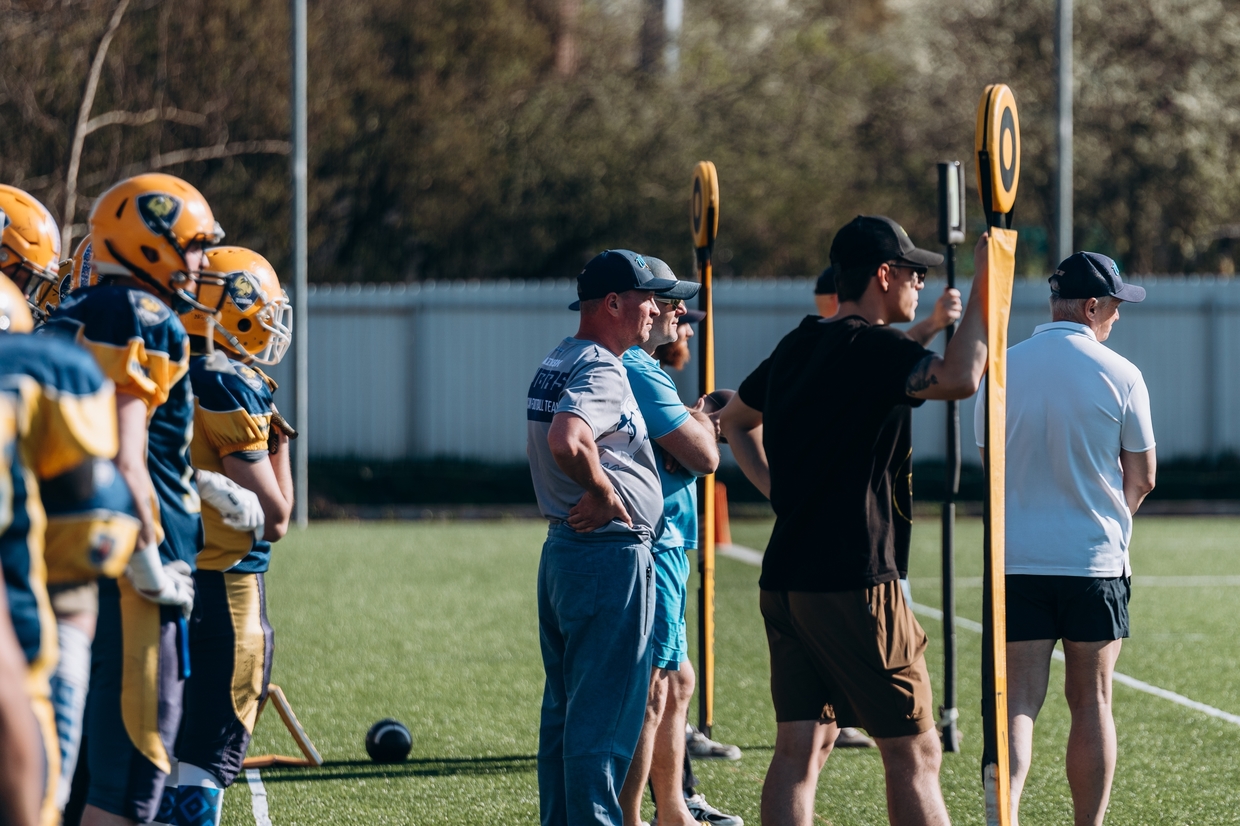
A nine-man league [A9FL] was set up this year and had three teams from Belarus (Zubrs, Litwins, and Hurricanes) and two from Russia (Patriots and Bears). Set up to succeed, it streamed online and got decent coverage in the national media, but an incident from the Hurricanes-Litwins playoff semifinal game precipitated a very public falling out amongst the Belarusian clubs.
The Litwins won the game and proceed to face the Zubrs in the final, but two Hurricanes had been ejected in the game. The A9FL management called for a meeting of team heads to decide if those ejections were legitimate, to the ire of the finalists, who decided to unilaterally play the final. The Moscow Bears, upon hearing the news, promptly withdrew from the league, leaving the competition with an uncertain future.
Rumors that the St. Petersburg Griffins and Moscow Dragons might join in 2027 persist, with a fourth club in Belarus also getting a chance to play. The resilient aficionados of American football are determined to not only keep the game alive, but to have it thrive, especially given the obstacles they’ve overcome. But they are less than a minority sport, they are a sport unknown by followers of the game in their own country.
On Christmas Day 2024, while down in Minsk for a shoot, I found myself at a loose end and ended up, surprisingly, in an Irish pub. Having a burger and beer, I found myself watching the Chiefs punish the Steelers, with a dozen American football fans, all locals. None ever played the game, but all had recently become Chiefs fans. One, happily inebriated 30-something ex-army officer named Sergey, told me, “I love Mahomes.” I kind of got that, as he was wearing a Chiefs shirt with Mahomes across the shoulders. “We come here and everything stops,” he grinned.
Another of the Chiefs cheerleaders, a stocky policeman whose name I never got, was totally unaware that there were teams playing in Belarus. “They’re probably sh*t!” he said with great gusto. There are lots of locals who love American football; they just don’t engage with the local version.
That’s what Pasha, an IT specialist who moved back from Germany in 2018 to found a start-up company, told me.
“In Germany, where I lived [Frankfurt], there was an active [football] community and leagues. Europe has a lot of Americans who join in and coach. But here, we have to do our best. For those of us who lived outside and felt it, it gives us something to believe in and that we’re part of a big world. And those who love the game but don’t involve with us, it’s their loss.”
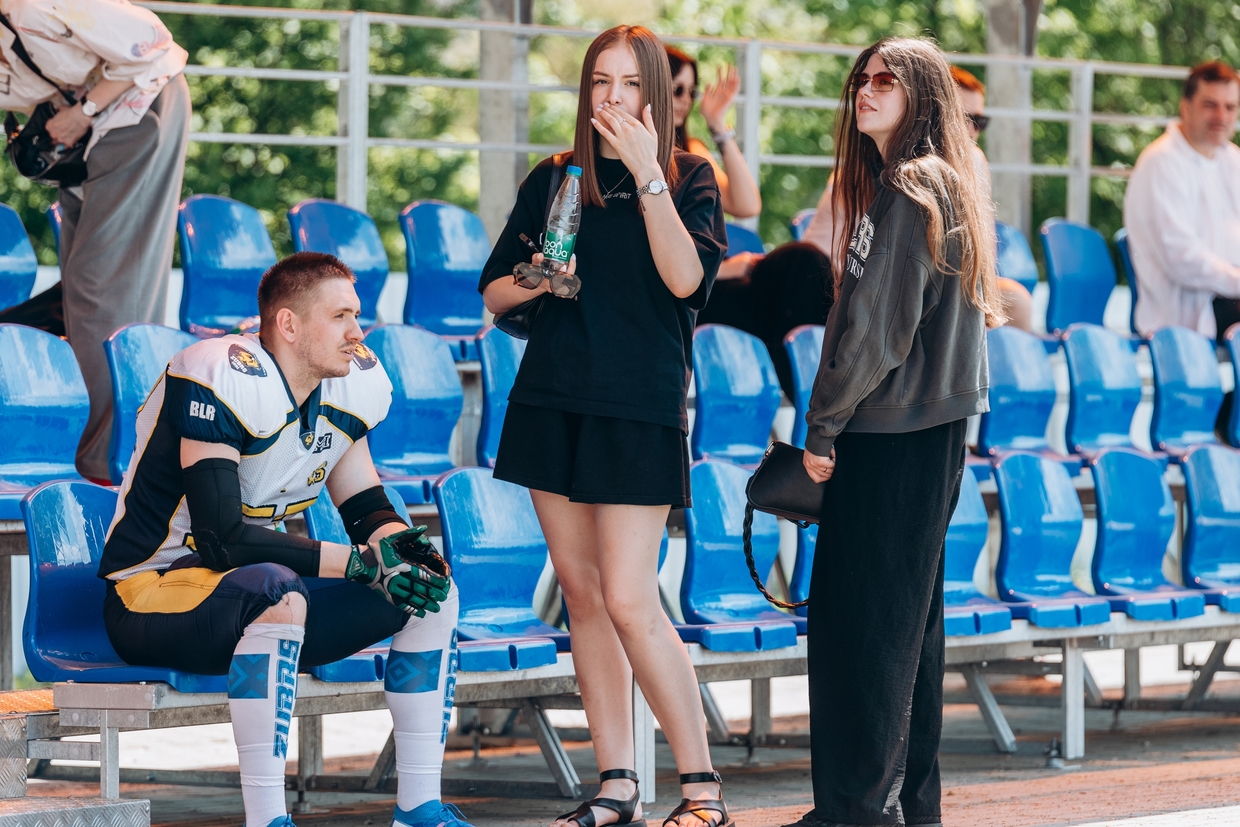
Since becoming a father, Pasha has become a spectator but is hopeful for the game’s future in his homeland. “I want my boys to play the game, but we have to have kids sections first.”
That is a major failing in the local game. They have relied on luring in enthusiasts from other sports, or international students, or the occasional American, to fill out their ranks.
Tatyana, a 26-year-old beautician whose husband has played for three different clubs in Belarus, told me that it’s not easy for them [clubs], but that they are what sport is about.
“It’s very difficult for coaching kids, so many regulations, costs, my husband wants, but work, money, time, no opportunity,” she said, adding that many of those playing are more concerned with getting games and “having the TV for themselves on Sundays for NFL.”
This May, on a warm Sunday afternoon, I was passing through Minsk and decided to take in the Hurricanes-Patriots game. The visitors from Moscow had a couple of familiar faces, ones I knew from playing rugby in Russia. On the go since 1999, they have been champions of Russia on at least 15 occasions and comport themselves like professionals.
There wasn’t the pageantry or excitement I saw, for example, in regional league football in Germany. Back in 1999, I went to see my home team the Marburg Mercenaries host the Straubing Spiders on a similar May day and there were cheerleaders, hotdogs, cold beer, and even fan engagement activities being run to recruit kids to the academy. The game in Minsk was more barebones, with the action on the field more important than the fan experience.
Despite being formed just last year, the Hurricanes put on a show to thrill a decent home crowd, blowing away the Russians in 66-36. I asked some of the spectators what they thought.
“It’s my first game live and I loved it. It makes [association] football look like little girls playing,” said Galina, a language student who was going to the US on an exchange program this past summer.
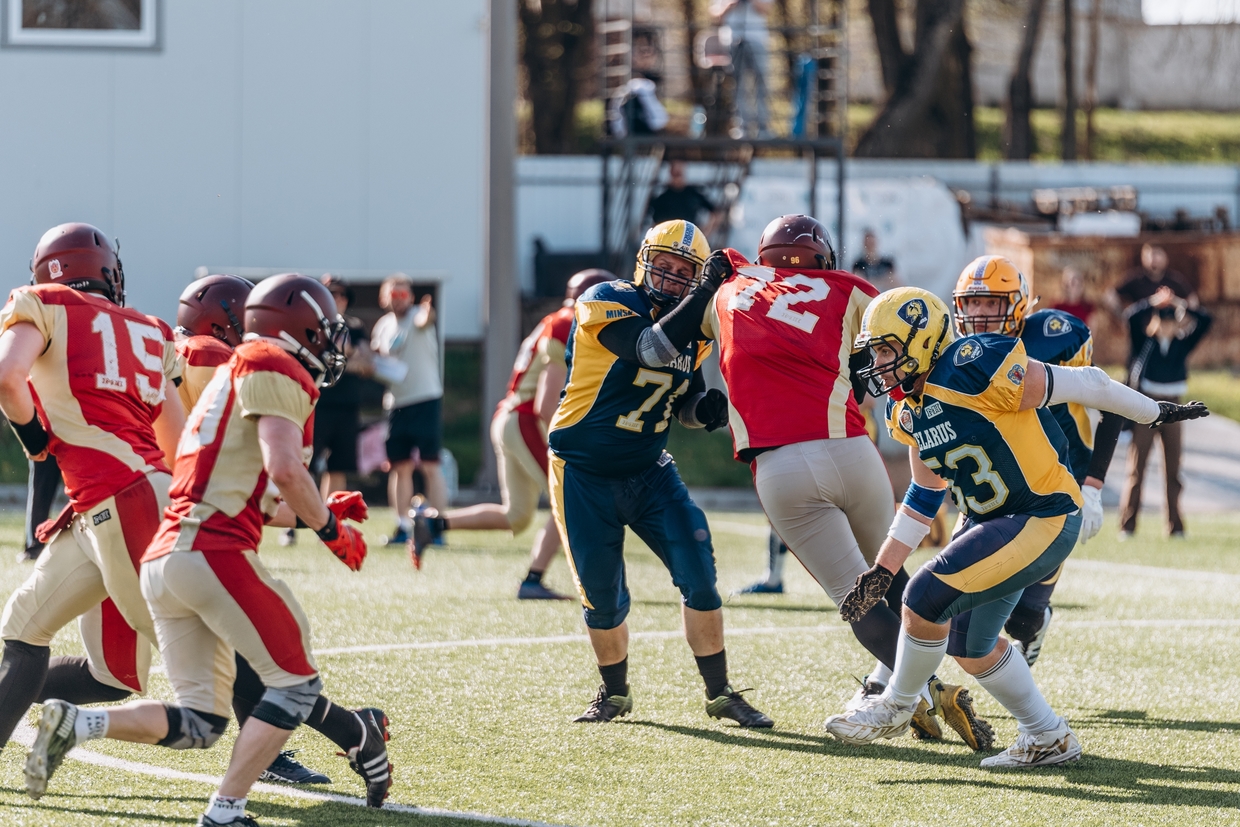
“My boyfriend is playing and I didn’t want to come to watch, I’m glad I did,” beamed Maria, whose beau caught a TD pass.
Speaking with some of the visiting players afterwards, I asked how difficult it’s been for them since 2022. Yuri, a versatility player who can play both ways, laughed and said that the game is what keeps him going some days.
“I played rugby and loved it. Then I moved [to Moscow from Siberia] and I joined the Patriots. That’s what, since 2018. It’s become like life. We meet on weekends to watch college ball or NFL, and we all like different teams and it’s very [democratic].”
I asked about the set-up in Minsk. “Hey, for the first time and a new club, they did a great job. It just needs time.”
Remember in the first Mighty Ducks movie, where Gordon Bombay’s players were all wearing cast-off gear or worn out kit, basically ‘Ragball Rovers’, as we’d say back in Ireland? I had a little feeling of that watching some of the games this season.
Not as bad as ‘The Waterboy’, where jockstraps were passed between players coming off and on the field – almost everyone had their own helmet, or an individual one – but there was a definite lack of some equipment, which hasn’t been helped by Belarus’ recent isolation.
“It’s a costly pastime,” Grigory laughed as we took a stroll in Gorky Park, the Minsk version. He was pushing a stroller with his nine-month old draining a bottle of formula and oblivious to our sports talk. “My wife said me, you have now a baby [their third], you can’t miss work with injury and then pay for all things.”
The graphic designer, who played two seasons, broke his right wrist, toes on both feet, dislocated his shoulder, and suffered two concussions. I should add he was a cornerback and safety.
“I miss it and the team, but not being injured,” he smiled and reminded me that he’d also broken “many” fingers. In his earlier sports life, he had played professional basketball.
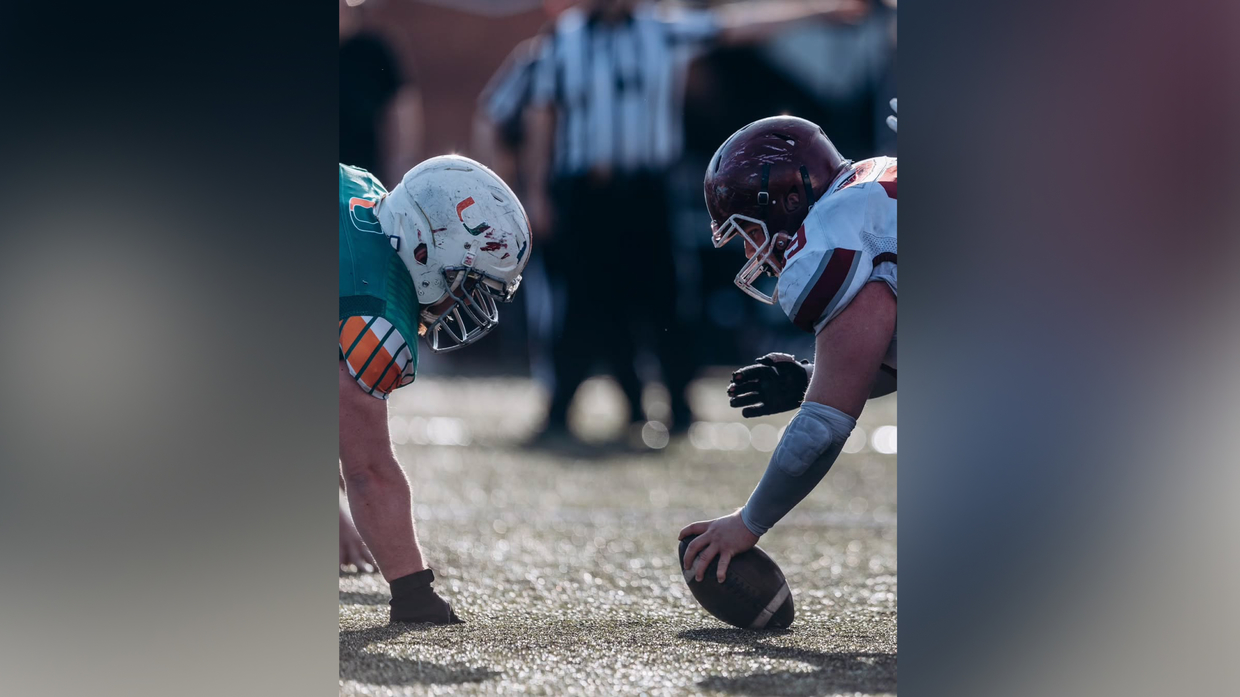
One of the minds behind the new A9FL league said that with the increased discourse between Belarus and the US, there might be a chance of links with “even high schools.” He said that in the past kit had been donated via Christian charities to teams in Belarus, and hoped that John Coale will work some magic there. Coale is the US special envoy to Belarus who has been instrumental in re-opening channels between Washington and Minsk.
But even if the thaw continues between Belarus and the US, can an amalgamated team from the nation return to European competition, now that there is a boom time for top level leagues on the continent?
The game in Europe has never been more popular, or fractured, than right now. The European League of Football (ELF), which began play in 2021, was gathering momentum until it wasn't, and infighting saw teams breakaway after the 2025 season and form not one, but two new leagues. Both began play in 2026.
The American Football League Europe (AFLE) and the European Football Alliance (EFA) went head-to-head this year, producing mixed results.
On September 6, the AFLE’s ‘Gold Bowl’ was ‘contested’ by the Vienna Vikings of Austria and Panthers Wroclaw of Poland. I say ‘contested’ as the Vikings, who finished the regular season 11-1 and averaging a respectable 5,278 fans, skewered the Poles 68-5. It was a fitting end to a confusing first season. As good as Vienna were, at the opposite end of the eight-team scale, Italy’s hapless Firenze Lions went winless through 12 games, drawing an average of…67 fans. Yes, you read that right. Numbers that even the original version of Vince McMahon’s XFL would be unable to put a positive spin on.
Rival league, the EFA, wrapped their season up with Denmark’s Nordic Storm overpowering Germany’s Munich Ravens 48-28 in the EFA Championship Game. A little more polished, also with local TV deals, broadcasts on YouTube, bigger sponsors, and just six teams, the EFA leaned into legacy by bringing in recognized names from the US. Former NFL Coach of the Year Jack Del Rio and ex-Carolina Panthers and Oakland Raiders coach John Shoop, both laid down markers in leading the Paris Musketeers and Nordic Storm to the playoffs. And investment in coaches and players showed in ticket sales with the Frankfurt Galaxy (4-6) averaging 5,197 fans and bottom feeders Prague Lions (2-8) still drawing 1,185.
Attempts to harmonize the two top leagues in Europe, and even re-unite the EFA with the ELF, have so far failed with both active leagues planning solo expansion in 2027. Neither outfit is interested in taking teams from Russia or Belarus.
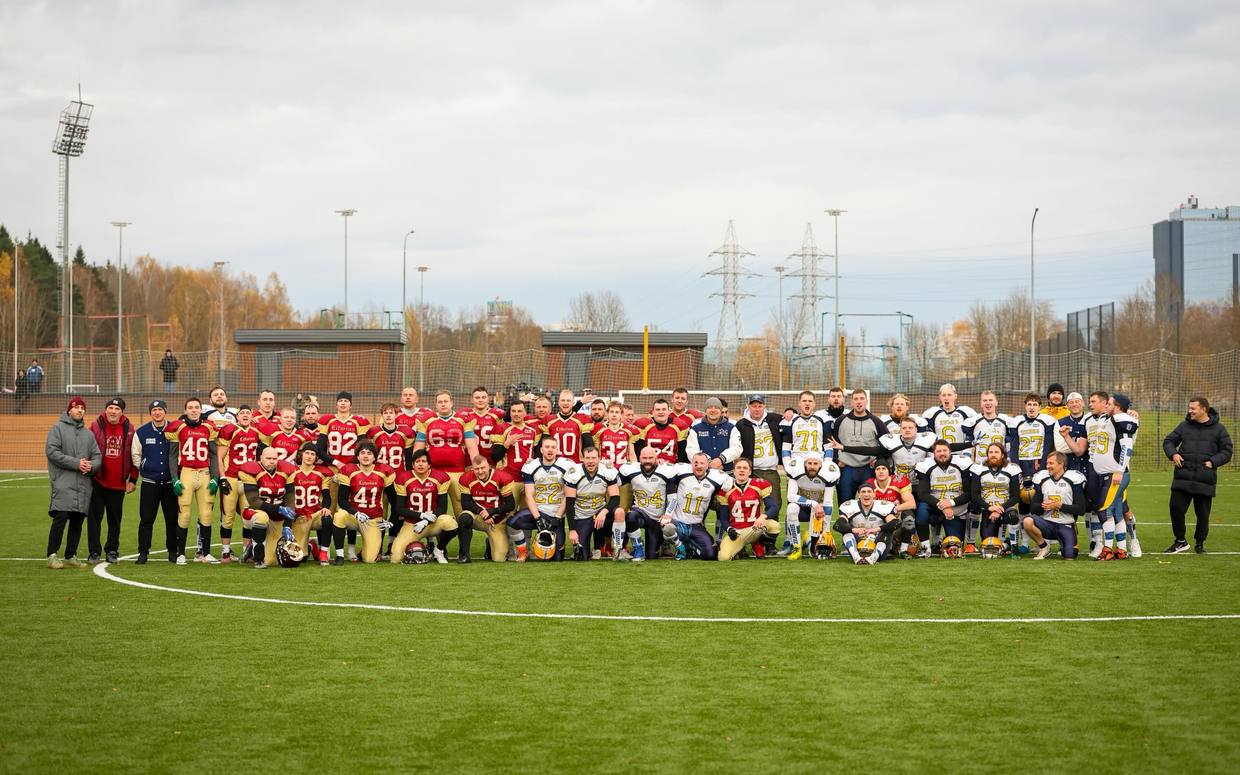
Former ELF chief Ingo Schiller told Capital Sports, in 2021, that having teams from the former Soviet Union, meaning the Baltic States, Ukraine, Belarus, and Russia, would only be a “positive” for American football in Europe. However, both the AFLE and EFA categorically ruled out accepting any teams from the five nations, with an AFLE executive, who didn’t wish to be named, telling the writer that “the league’s American owners would be happy enough, but could you just imagine the idiots protesting if Minsk or Moscow came to play in Poland or Germany?”
When I joked that Belarusian newcomers the Hurricanes were drawing more than 67 fans to games, the executive laughed and said “Europe is not in a good place right now.”
The A9FL offers much needed hope. If they continue play in 2027, holding onto the four existing teams and adding one or two new ones, sponsors and media attention will continue.
Ex-Zubrs player Yevhen is confident that the league will continue, “It got the attention of the media, even the national sports channel [Belarus 5] and the club will have more players because of it. You can’t just train and train without a chance of playing.”
A sports journalist with Belarus 5 was keen to point out that not being just a local league means something. “In the KHL [Kontinental Hockey League], the interest is high because Dinamo Minsk play Russia, Kazakhstan, it’s national pride. And American football is too. If they are beating Russian clubs, then we Belarusians are proud.”
Keeping the sport alive is enough to be proud of. However, if they manage to keep the current A9FL going for another couple of seasons and start to set up youth structures, it will revive the game in the Belarusian provinces and create a sustainable ecosystem.
So who knows, maybe an NCAA college team or two will find a nugget in Belarus, or one of the top European leagues will invite a franchise from the country to take part. No matter what, the games in Minsk will definitely, beyond the shadow of a doubt, average more than 67 fans per game.